- Contact Us Now: (415) 968-1780 Tap Here To Call Us


The IRS’s Aggressive New Crypto Audit Form: Why You Shouldn’t Sign It


The “Wild West” days of cryptocurrency taxation are officially over. As part of a massive new enforcement wave, the Internal Revenue Service has begun deploying an extraordinarily aggressive new tool in its examinations of digital asset investors.
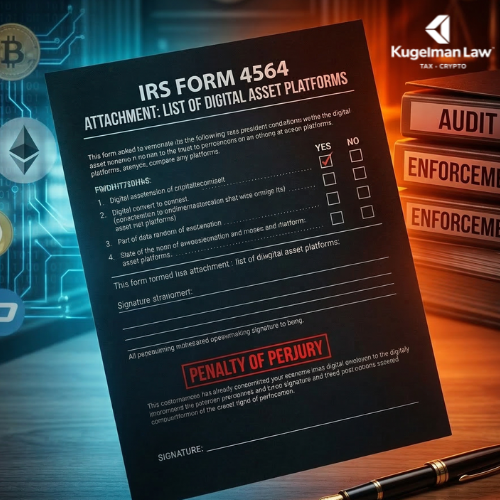
Recently highlighted by prominent voices in the crypto tax community, the IRS Small Business/Self-Employed (SB/SE) Division is now attaching a deeply invasive questionnaire to its standard audit notices.
At a high level, the IRS is asking for the exact same information that has traditionally been requested during a crypto audit. However, this new form asks you to confirm your history item-by-item (yes/no) and then demands you sign it under penalty of perjury.
If you receive this document, do not blindly fill it out. Here is what you need to know about this new audit form, why the IRS is using it, and why consulting a crypto tax attorney is absolutely critical before you sign your name.
What is the New IRS Crypto Audit Form?
Unlike standard, numbered IRS tax forms like a Schedule D or the new Form 1099-DA, this new document is an examination attachment. It typically arrives stapled to a Form 4564 (Information Document Request, or IDR) during an active civil tax audit. You can view a blank standard Form 4564 on the IRS website here.
Historically – such as on Question 3 of a standard crypto tax audit IDR – the IRS simply asked taxpayers to list their exchanges and wallets. If the taxpayer is working with a savvy crypto tax attorney, the response would provide the information requested “to the best of the taxpayer’s recollection,” but the taxpayer was not swearing to its absolute perfection under threat of perjury.
This new attachment changes the game. Titled “List of Digital Asset Platforms, Wallets, Services, and Products Used,” it acts as a comprehensive dragnet designed to map out your entire digital financial history.
Part I: Centralized Exchanges (The Unlimited Look-Back)
Part I provides a pre-printed checklist of over 100 cryptocurrency exchanges. For each platform, you are asked to provide a strict Yes/No on whether you used it, the exact date you first used it, and associated usernames.
The Danger: The form traps you into divulging information from other years that are entirely outside the scope of your current audit.
Part II: Wallets, DeFi, and Self-Custody
Part II proves the IRS is looking far beyond centralized exchanges. It lists self-custody wallets and DeFi products, demanding to know which blockchain networks you interacted with and a description of your activities.
Part III: The Perjury Certification
This is the ultimate trap. After filling out pages of historical data, you must sign a certification that reads:
“Under the penalties of perjury, I declare that I have examined these statements and to the best of my knowledge and belief, they are true, correct, and complete.”
The Trap: Why the IRS is Using This Form
The IRS is attempting to get taxpayers on the record saying affirmatively “yes” or “no.” The glaring problem is that almost no one has perfectly complete records or perfectly remembers every random altcoin they traded 3, 5, or 10 years ago.
If you forget a platform you used once in 2017 and check “No,” you have just submitted a sworn, false statement to a federal agent. Conversely, if you painstakingly disclose too many platforms out of fear, you have just handed the auditor a roadmap to expand your audit into new years and new lines of inquiry.
The Big Misstep: Revenue Agents and Subject Matter Experts
During a crypto audit, the standard IRS Revenue Agent is going to rely heavily on internal Subject Matter Experts (SMEs). These SMEs use advanced blockchain analytics tools to look for activity and data regarding “sends” and “receives” from other platforms.
If you sign this form and provide your yes/no answers before doing your own forensic crypto accounting, reconstruction, and reconciliation, you are making a massive misstep. If your memory-based “no” contradicts the immutable blockchain send/receive data the SME has already mapped out, your credibility is destroyed, and you face severe penalties.
How a Crypto Tax Attorney Protects You
The most important takeaway for any taxpayer facing this new form is this: There is no reason to sign this under penalty of perjury, and there is no legal requirement to do so.
When you hire a specialized crypto tax law firm like Kugelman Law, our first step is to intervene and protect you from this trap. An experienced tax attorney will:
- Change the Format: We will not let you fill out their yes/no checkboxes. Instead, we provide the requested information in a carefully drafted narrative or letter form. This satisfies the auditor’s request without exposing you to a perjury trap based on a faulty memory.
- Reconcile First: We synthesize your blockchain transaction logs using forensic crypto accounting before anything is submitted to the IRS. We ensure your narrative matches the blockchain data the SMEs are already looking at.
- Limit the Scope: We aggressively push back on attempts to expand the audit. We work to restrict the IRS’s reach to the specific tax years currently under examination, preventing fishing expeditions into your past.
The deployment of this new form signals a hostile era of IRS cryptocurrency enforcement.
If you receive an audit notice or a Form 4564 demanding your crypto history, do not sign it. Contact Managing Attorney Alex Kugelman and the expert crypto tax team at Kugelman Law immediately.
We will protect your rights, limit the IRS’s scope, and provide the information requested safely and strategically.