- Contact Us Now: (415) 968-1780 Tap Here To Call Us


IRS Audit Defense for Fresno Agricultural Businesses


Fresno County is the undisputed agricultural powerhouse of the United States. From sprawling almond orchards in Coalinga and raisin vineyards in Selma to multi-generational packing houses in Clovis, the Central Valley feeds the world.
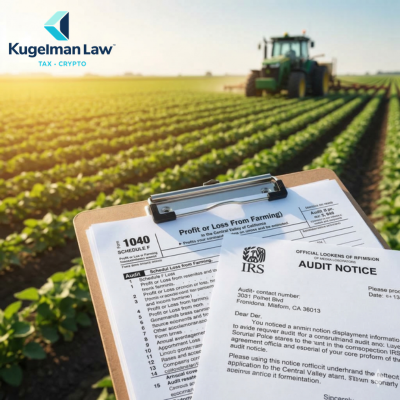
But this massive economic output brings intense, specialized scrutiny from the Internal Revenue Service (IRS) and the California Franchise Tax Board (FTB).
The IRS does not audit a farm the same way it audits a tech startup. They have a dedicated set of rules, specialized training manuals (known as the Farmers Audit Technique Guide), and examiners who specialize specifically in agricultural economics.
If you operate a farming or agribusiness in the San Joaquin Valley, an audit is rarely a simple paperwork check. It is a forensic deep-dive into your entire operational structure.
The Schedule F Bullseye: What the IRS is Looking For
Most agricultural operations, whether sole proprietorships or single-member LLCs, report their income and expenses on a Schedule F (Profit or Loss From Farming). Because farming is capital-intensive and subject to wild revenue swings based on weather, drought, and commodity prices, the IRS looks for specific discrepancies to challenge your deductions.
1. Equipment Depreciation and Section 179
Farms rely on heavy, expensive machinery. Tractors, harvesters, irrigation pivots, and processing equipment cost hundreds of thousands of dollars. The tax code allows farmers to aggressively deduct these costs using Section 179 and Bonus Depreciation, sometimes deducting the entire purchase price in the first year.
However, IRS auditors aggressively scrutinize these claims. They will demand proof that the equipment was “placed in service” during the tax year claimed.
They will also look closely at vehicles like heavy-duty pickup trucks to ensure you are strictly separating business use from personal use. If an auditor finds that a truck written off under Section 179 is being used for family trips around Fresno, they will disallow the deduction and assess heavy penalties.
2. The “Cash Economy” of Farm Labor
Agriculture is heavily reliant on seasonal, migrant, and day labor. The IRS categorizes businesses with high cash transactions as “high risk” for tax evasion. If your farm uses cash to pay laborers, independent contractors, or local vendors, you are operating in the crosshairs.
Examiners will use “economic reality” tests and indirect methods to reconstruct your income. If they see large cash payrolls without corresponding 1099s or W-2s, they will assume any undocumented cash came from unreported crop sales.
Reconstructing these records requires a specialized tax audit attorney who can invoke legal doctrines (like the Cohan Rule) to estimate allowable expenses when physical receipts are missing.
3. Hobby Farm vs. For-Profit Classifications
Farming is tough, and it is not uncommon for Central Valley ranches to report net losses for several consecutive years due to drought or market crashes. If you report losses year after year, the IRS may attempt to reclassify your operation as a “hobby” rather than a legitimate for-profit business under IRC Section 183.
This is a devastating reclassification. If your farm is deemed a hobby, your business deductions are completely disallowed, meaning you cannot write off your feed, fertilizer, labor, or equipment against your other income.
Defending against this requires proving your “profit motive” by demonstrating a business-like manner, expert consultation, and historical expectations of asset appreciation.
4. Prepaid Farm Supplies
Farmers often buy seed, fertilizer, and feed at the end of the year to lock in prices and take a tax deduction for the current year, even if the supplies won’t be used until the spring planting season.
The IRS heavily audits these prepaid expenses. To deduct them, you must prove the purchase was an actual purchase (not just a deposit), that it had a specific business purpose, and that it doesn’t materially distort your income.
Defending the Family Farm: Why You Need a Tax Attorney
A standard CPA is often not equipped to handle the hostile environment of a specialized IRS agricultural audit. When the IRS brings in its Subject Matter Experts, you need a legal defense strategy that understands the nuances of crop cycles, agricultural co-ops, drought-year casualty losses, and complex asset basis calculations.
At Kugelman Law, we protect Central Valley agribusinesses. We know that your farm is more than a business; it is your family’s legacy.
Whether you are facing a grueling cash-intensive business tax audit, a dispute over your agricultural payroll, or a massive depreciation adjustment, our Fresno tax resolution attorneys intervene to limit the IRS’s scope, reconstruct lost records, and fight for your livelihood.
Do not face the IRS alone. Contact us today for a confidential consultation.